- Physics vs. Generic Solvers: Accelerating Product R&D Timelines with Tailored Code
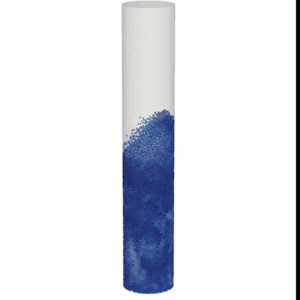 In the race to bring innovative products to market, speed and accuracy are the ultimate determinants of competitive advantage. Across industries like aerospace, automotive, renewable energy, and biomedical engineering, Computational Fluid Dynamics (CFD) serves as a primary vehicle for rapid prototyping. However, a silent bottleneck often stalls development cycles: the reliance on generic, all-purpose commercial… Read more: Physics vs. Generic Solvers: Accelerating Product R&D Timelines with Tailored Code
 - Democratizing Simulation: Designing App-Specific CFD Toolkits to Free Up Senior Engineers
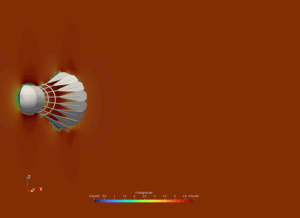 Computational Fluid Dynamics (CFD) has historically been an elite engineering discipline, restricted to a small circle of specialists who possess deep expertise in advanced fluid physics, numerical methods, and high-performance computing. Within a traditional manufacturing or aerospace enterprise, these senior simulation engineers act as the ultimate gatekeepers of product performance. However, as product development cycles… Read more: Democratizing Simulation: Designing App-Specific CFD Toolkits to Free Up Senior Engineers
 - The Per-Core Penalty: How Traditional Simulation Pricing Halts Enterprise Scaling
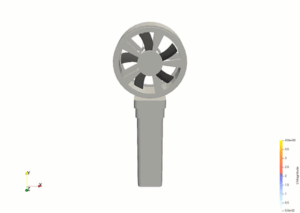 In the digital era, high-fidelity engineering simulation is no longer a luxury reserved for niche research laboratories; it is a foundational component of modern product development. Companies across aerospace, automotive, renewable energy, and heavy manufacturing rely on Computational Fluid Dynamics (CFD) to optimize designs, cut physical prototyping costs, and accelerate time-to-market. The underlying hardware required… Read more: The Per-Core Penalty: How Traditional Simulation Pricing Halts Enterprise Scaling
 - Protecting Core IP: Why Relying on Black-Box CFD Software is a Valuation Risk
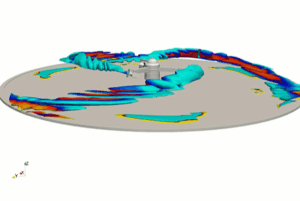 In an increasingly competitive global marketplace, a company’s valuation is intimately tied to its proprietary technology and intellectual property (IP). For engineering-driven organizations—whether operating in aerospace, automotive, renewable energy, or specialized manufacturing—the core vectors of innovation are frequently discovered, tested, and optimized through simulation. Computational Fluid Dynamics (CFD) serves as the primary digital proving ground… Read more: Protecting Core IP: Why Relying on Black-Box CFD Software is a Valuation Risk
 - How Commercial CFD License Inflation Erodes Engineering Margins (And How to Pivot)
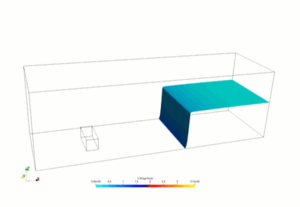 In modern engineering consulting and product development, simulation throughput has a direct linear relationship with innovation velocity. Over the past decade, however, engineering departments have encountered a systemic threat to their operational profitability: the aggressive inflation of commercial Computational Fluid Dynamics (CFD) licensing fees. Proprietary suites from major vendors have steadily evolved their pricing models… Read more: How Commercial CFD License Inflation Erodes Engineering Margins (And How to Pivot)
 - Building Custom GUI Front-Ends for Complex OpenFOAM Solvers: Democratizing CFD for Non-Experts
 Computational Fluid Dynamics (CFD) has historically been an elite engineering discipline, restricted to specialists who possess deep knowledge of numerical mathematics, fluid physics, and high-performance computing. Within this landscape, OpenFOAM stands out as an incredibly powerful but notoriously unyielding ecosystem. Operating entirely via text-based dictionaries and command-line interfaces, its steep learning curve often excludes product… Read more: Building Custom GUI Front-Ends for Complex OpenFOAM Solvers: Democratizing CFD for Non-Experts
 - The Hidden Security Risks of Using Third-Party Commercial CFD Code
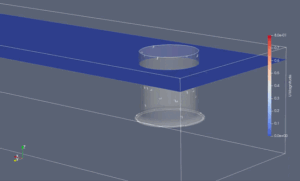 Computational Fluid Dynamics (CFD) is no longer confined to isolated research labs; it is embedded deeply within the core engineering pipelines of aerospace, defense, automotive, and nuclear sectors. Because CFD models are used to optimize critical infrastructure, military hardware, and highly proprietary manufacturing technologies, the data driving these simulations represents an organization’s most valuable intellectual… Read more: The Hidden Security Risks of Using Third-Party Commercial CFD Code
 - Demystifying CFD Validation: How to Guarantee Code Accuracy Against Experimental Data
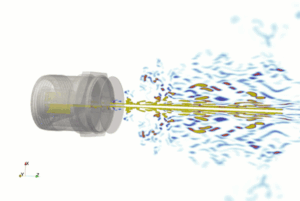 In industrial engineering, a Computational Fluid Dynamics (CFD) simulation is only as valuable as it is reliable. While modern solvers can generate visually stunning flow visualizations and high-resolution pressure plots, they remain mathematical approximations of physical reality. Without rigorous verification and validation, these colorful animations risk becoming expensive guesswork. For engineering departments deploying simulations to… Read more: Demystifying CFD Validation: How to Guarantee Code Accuracy Against Experimental Data
 - In-House CFD Software: Build vs. Buy Guide for Engineering Managers
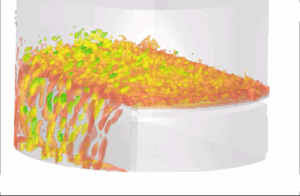 Engineering managers face a persistent strategic dilemma when scaling their department’s simulation capabilities: should they continue purchasing commercial licenses for proprietary Computational Fluid Dynamics (CFD) software, or should they invest in building a custom, in-house simulation engine? As product development cycles compress and multi-disciplinary optimization becomes the norm, the financial and operational strains of traditional… Read more: In-House CFD Software: Build vs. Buy Guide for Engineering Managers
 - Accelerating OpenFOAM: Porting Solvers to GPU vs. CPU High-Performance Clusters
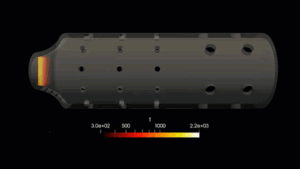 In the world of Computational Fluid Dynamics (CFD), time-to-solution is the ultimate currency. As engineering teams demand higher fidelity models, larger mesh sizes, and more extensive parametric design loops, traditional computing infrastructures face unprecedented strain. Within the OpenFOAM ecosystem—historically built to leverage standard Central Processing Unit (CPU) clusters via Message Passing Interface (MPI)—a massive architectural… Read more: Accelerating OpenFOAM: Porting Solvers to GPU vs. CPU High-Performance Clusters
 - Automating the Pipeline: How to Build Hands-Free Volume Meshing for Complex CAD Geometries
 In the field of Computational Fluid Dynamics (CFD), the path from a computer-aided design (CAD) model to a high-fidelity simulation result is notorious for its bottlenecks. Among these steps, volume meshing—the process of dividing a continuous physical domain into millions of discrete geometric cells—is traditionally the most labor-intensive. When dealing with complex, production-grade CAD geometries… Read more: Automating the Pipeline: How to Build Hands-Free Volume Meshing for Complex CAD Geometries
 - Moving Beyond UDFs: When to Modify OpenFOAM Source Code Directly
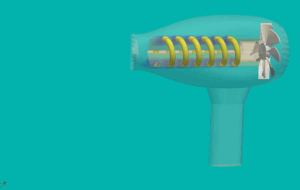 In the realm of Computational Fluid Dynamics (CFD), customization is often the dividing line between standard engineering and breakthrough innovation. When proprietary commercial solvers reach their limits, engineers typically rely on User-Defined Functions (UDFs) to introduce custom boundary conditions, variable physical properties, or basic source terms. While UDFs serve as an acceptable band-aid for minor… Read more: Moving Beyond UDFs: When to Modify OpenFOAM Source Code Directly
 - What is OpenFOAM? A Beginner’s Guide to Open-Source Fluid Dynamics
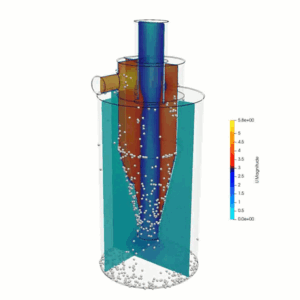 Computational Fluid Dynamics, commonly known as CFD, is a branch of fluid mechanics that uses numerical analysis and data structures to analyze and solve problems involving fluid flows. In modern engineering, CFD acts as a virtual wind tunnel or laboratory, allowing designers to simulate how air moves over a sports car, how water flows through… Read more: What is OpenFOAM? A Beginner’s Guide to Open-Source Fluid Dynamics
 - Commercial CFD vs. Open-Source CFD: A Comprehensive Cost and Feature Comparison
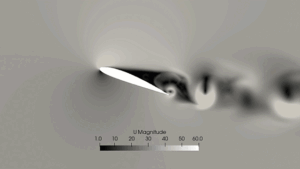 Computational Fluid Dynamics (CFD) has become an indispensable pillar of modern engineering, enabling companies to simulate fluid flow, heat transfer, and chemical reactions before physical prototypes are ever built. As industries face mounting pressure to innovate rapidly while slashing development costs, selecting the right simulation ecosystem is a critical strategic decision. The market is primarily… Read more: Commercial CFD vs. Open-Source CFD: A Comprehensive Cost and Feature Comparison
 - Hello world!Welcome to WordPress. This is your first post. Edit or delete it, then start writing!