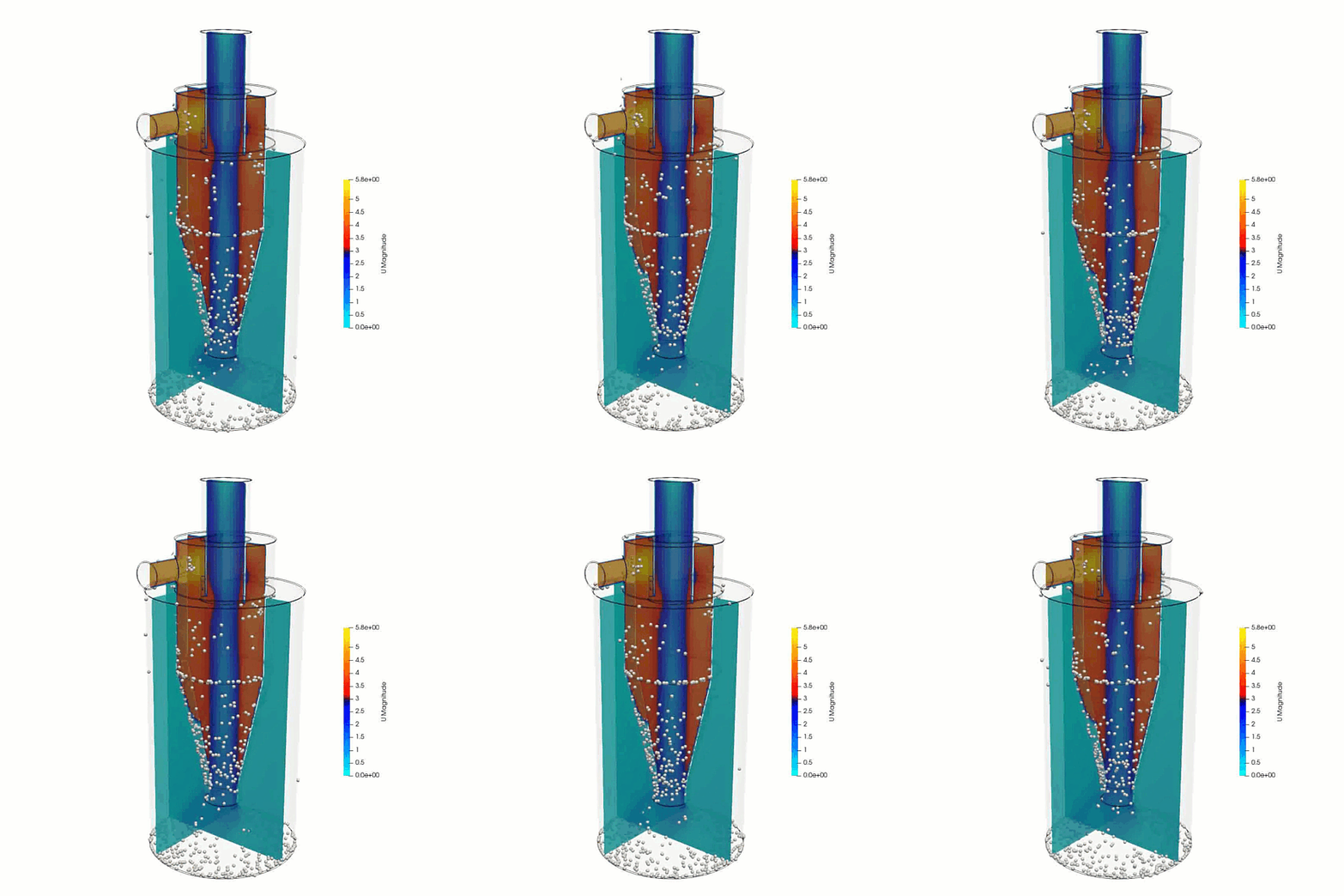
Computational Fluid Dynamics, commonly known as CFD, is a branch of fluid mechanics that uses numerical analysis and data structures to analyze and solve problems involving fluid flows. In modern engineering, CFD acts as a virtual wind tunnel or laboratory, allowing designers to simulate how air moves over a sports car, how water flows through a turbine, or how heat dissipates inside a smartphone. For decades, performing these complex simulations required extremely expensive proprietary software. OpenFOAM has completely changed this landscape by offering a powerful, accessible, and entirely free alternative that has become a cornerstone of both academic research and industrial engineering worldwide.
Understanding the OpenFOAM Framework
OpenFOAM stands for Open Source Field Operation and Manipulation. Developed primarily by OpenCFD Ltd and the OpenFOAM Foundation, it is not a single software application in the traditional sense, but rather a vast, modular collection of C++ libraries. At its core, OpenFOAM is designed to solve complex systems of partial differential equations, making it capable of simulating far more than just fluid dynamics. It can handle solid mechanics, electromagnetics, and finance modeling. Because it is written in highly structured object-oriented C++, the software mirrors mathematical tensor operations directly in the code, allowing engineers to read and write equations in a syntax that closely resembles standard mathematical notation.
The Power of the Open Source Model
The defining characteristic of OpenFOAM is its distribution under the GNU General Public License. This means the software is completely free to download, use, modify, and distribute. In commercial CFD applications, companies must purchase expensive licenses that are often tied to the number of processor cores being used. If an engineer wants to scale up a simulation to run on a massive high-performance computing cluster with hundreds of cores, the licensing fees can quickly become astronomical. OpenFOAM eliminates this barrier entirely. It allows unlimited parallel processing across an infinite number of computing nodes without any software licensing costs, democratizing high-fidelity engineering simulations for startups and giant enterprises alike.
Navigating the Command Line Workflow
Unlike commercial CFD packages that feature highly polished graphical user interfaces, standard OpenFOAM operates primarily through a command-line interface. For beginners, this text-driven environment can feel intimidating. An OpenFOAM case is organized as a strict directory structure containing various text files known as dictionaries. These dictionaries define everything from the geometric grid and physical properties of the fluid to the numerical schemes and boundary conditions of the simulation. While this lack of a visual interface creates a steep learning curve, it rewards users with absolute control. Every single parameter of the simulation is explicitly stated in plain text, making workflows highly reproducible and easy to automate using basic scripting.
The Three Stages of an OpenFOAM Simulation
Every CFD simulation follows a three-step pipeline: pre-processing, solving, and post-processing, and OpenFOAM handles each distinct stage. Pre-processing involves defining the geometry and generating the computational mesh or grid. OpenFOAM includes built-in meshing utilities like blockMesh for simple geometries and snappyHexMesh for complex, multi-component industrial shapes. The solving stage is where the heavy mathematics happen. OpenFOAM features hundreds of pre-built solvers tailored to specific physical scenarios, such as incompressible flow, compressible aerodynamics, multiphase chemical reactions, and buoyancy-driven heat transfer. Finally, for post-processing and visualizing the results, OpenFOAM integrates seamlessly with ParaView, an open-source, multi-platform data analysis and visualization application.
Customization and Code Transparency
In proprietary software suites, the physics models and mathematical algorithms are locked away inside a hidden code environment. If a simulation behaves unexpectedly, engineers can only tweak external settings without knowing exactly how the software is calculating the flow. OpenFOAM completely strips away this limitation. Because the entire source code is fully transparent, users can open up any solver or turbulence model to see exactly how the equations are discretized and solved. This unmatched transparency allows research and development teams to customize existing solvers or write entirely new physical models from scratch, enabling companies to build proprietary simulation methodologies that are perfectly tailored to their unique products.
Overcoming the Learning Curve and Community Support
The flexibility and power of OpenFOAM come with the trade-off of a demanding learning curve. New users must become comfortable with Linux environments, C++ compilation, and the nuances of numerical stability without the safety nets often built into commercial software. Fortunately, because OpenFOAM has been widely adopted globally, a massive and highly collaborative community has evolved around it. Beginners can find extensive guidance through community-driven wikis, crowded discussion forums, annual workshops, and open-source tutorials. While it lacks a corporate helpline, the collective knowledge of thousands of academic researchers and industrial practitioners ensures that answers to common technical roadblocks are readily available.
Driving Innovation with OpenFOAM
OpenFOAM has evolved from an academic curiosity into an industry-standard powerhouse utilized by top-tier automotive companies, aerospace manufacturers, and renewable energy innovators. It bridges the gap between scientific theory and practical engineering, giving teams the freedom to innovate without financial constraints. By shifting the financial investment away from recurring software licenses and toward internal engineering expertise, companies can build a deeply knowledgeable workforce capable of pushing the boundaries of what is possible in fluid dynamics, heat transfer, and multiphysics design.
If your organization recognizes the immense power of this open-source engine but wants to bypass the steep operational learning curve, Tensor CFD can bridge the gap by developing a custom, in-house CFD software built explicitly on a ruggedized OpenFOAM backbone. We specialize in transforming the raw, command-line complexity of OpenFOAM into a tailored enterprise solution, complete with modern user interfaces and automated, application-specific workflows designed around your unique engineering goals. By encapsulating OpenFOAM’s infinite parallel scalability within a streamlined, proprietary application, Tensor CFD allows your team to deploy high-performance simulation capabilities across your entire department without per-core licensing fees or complex programming bottlenecks, accelerating your product development cycle while securing your unique intellectual property.
Leave a Reply