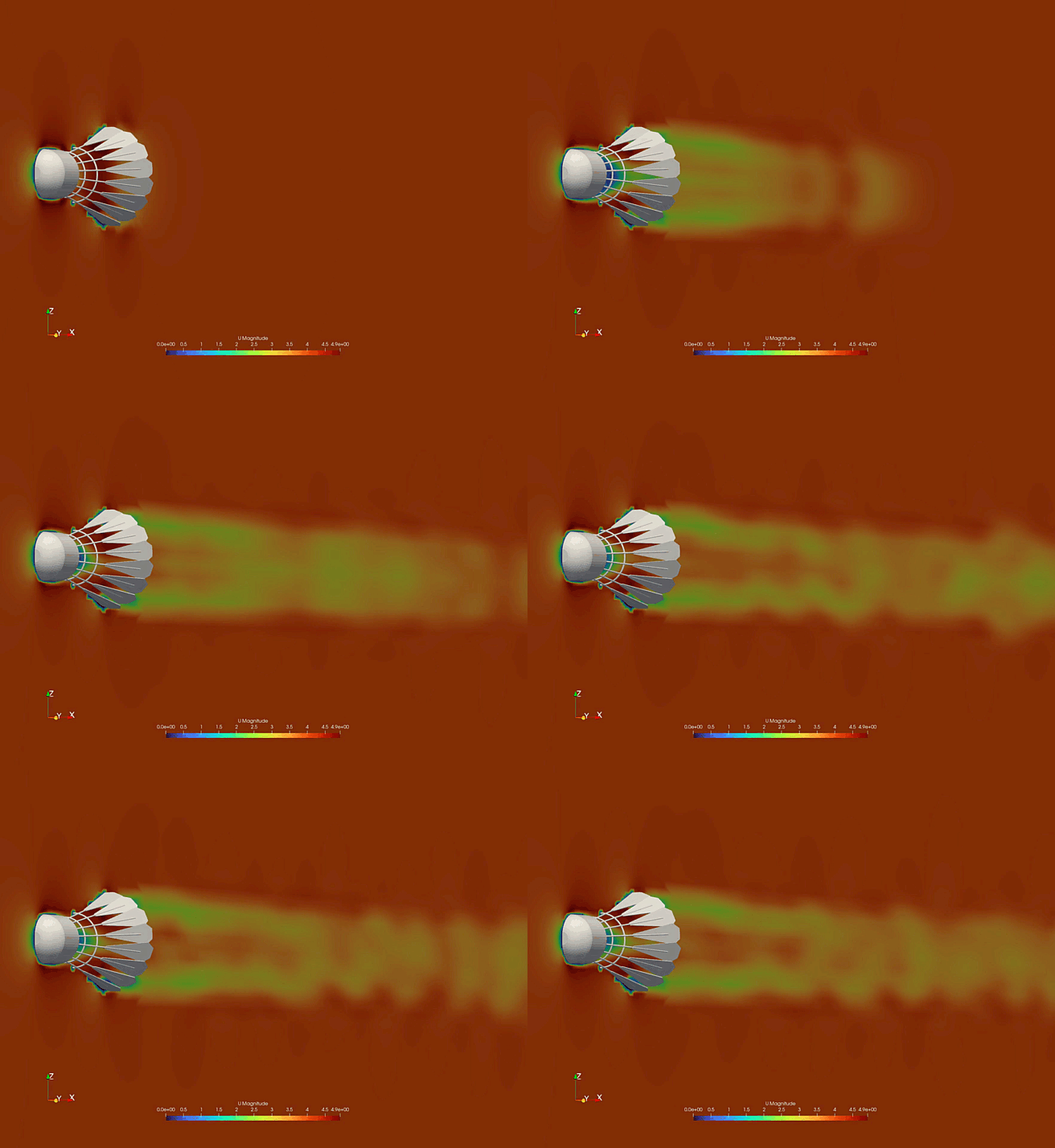
Computational Fluid Dynamics (CFD) has historically been an elite engineering discipline, restricted to a small circle of specialists who possess deep expertise in advanced fluid physics, numerical methods, and high-performance computing. Within a traditional manufacturing or aerospace enterprise, these senior simulation engineers act as the ultimate gatekeepers of product performance. However, as product development cycles compress and the demand for data-driven design grows, this centralized model creates an intense operational bottleneck. Senior engineers spend a massive portion of their valuable time performing routine, repetitive simulation tasks for other departments rather than focusing on breakthrough innovation. To break this logjam, forward-thinking organizations are changing their approach by wrapping complex simulation engines inside intuitive, application-specific toolkits, effectively democratizing CFD across the wider enterprise.
The Operational Strain on Senior Simulation Talent
In a conventional research and development environment, the workflow between product designers and the simulation team is highly inefficient. A designer creates a new geometric variation in a Computer-Aided Design (CAD) program and submits a request to the CFD department to analyze its aerodynamic or thermal performance. A senior engineer must then manually ingest the CAD file, clean up surface geometries, generate a computational mesh, configure solver physics, monitor convergence, and compile a static report.
This manual process creates a dual operational penalty. First, product designers face long lead times, often waiting days or weeks for basic feedback, which slows down the pace of design iteration. Second, and more critically, it misallocates highly compensated human capital. Senior engineers, whose primary corporate value lies in inventing new physical models, troubleshooting complex failures, and steering long-term technology roadmaps, are reduced to acting as software operators. They end up repeating identical configuration steps for minor design variants, leading to professional stagnation and underutilized corporate expertise.
The Strategy of Application-Specific Abstraction
Democratizing simulation does not mean handing a comprehensive, general-purpose commercial CFD suite to a non-expert. Forcing a product designer or a sales engineer to navigate thousands of generic buttons, choose between disparate discretization schemes, or manually tune relaxation factors is a recipe for disaster. Without deep domain knowledge, non-experts can easily generate highly flawed, unphysical simulations that appear superficially correct but lead to catastrophic design errors down the line.
True democratization relies on radical abstraction through application-specific design. Instead of building a tool that tries to do everything, software architects construct highly focused, specialized toolkits tailored to a single, repeatable corporate application. For instance, if a company specializes in designing industrial heat exchangers, the user interface is stripped of all generic CFD terminology. The non-expert user is not asked to choose a turbulence model or set an algebraic solver tolerance. Instead, the interface presents simple, intuitive inputs: flow rate, fluid type, and core dimensions. The underlying mathematical and physical complexity is completely hidden behind a robust, pre-configured template designed by the senior team.
Automating the End-to-End Simulation Pipeline
To make an app-specific toolkit successful for non-experts, the entire simulation lifecycle—pre-processing, solving, and post-processing—must be fully automated through programmatic scripting. The toolkit must handle raw CAD geometries without requiring human pre-processing. When a non-expert uploads a design file, background scripts automatically apply surface-insensitive meshing algorithms to generate a valid computational grid, bypassing the traditional bottleneck of manual geometry repair.
Similarly, the solving and post-processing stages must operate autonomously. The toolkit injects the user’s operational inputs directly into tailored boundary conditions, launches the parallel solver across high-performance computing clusters, and monitors convergence via algorithmic gatekeepers. Once the simulation concludes, the software automatically extracts key engineering metrics—such as total pressure drop, thermal efficiency, or drag coefficients—and compiles them into a clean, standardized report. This execute-and-forget pipeline transforms a complex multi-stage engineering workflow into a simple, push-button utility.
Scaling Without Licensing Constraints
When an enterprise attempts to scale simulation access using traditional commercial software, it encounters a severe financial barrier. Proprietary CFD vendors charge substantial annual royalties for every user seat and enforce strict per-core parallel licensing penalties. Providing every product designer, test technician, and sales engineer with access to commercial software licenses is financially impossible for most corporate budgets, creating an artificial ceiling on enterprise simulation throughput.
By building custom app-specific toolkits upon an open-source framework like OpenFOAM, organizations can decouple enterprise scaling from financial penalty. Because open-source frameworks carry zero licensing fees or core-count royalties, a custom toolkit can be deployed across an infinite number of corporate users and scaled across thousands of computing nodes simultaneously. This financial freedom allows an enterprise to truly democratize its simulation capabilities, embedding advanced predictive physics into every stage of the product lifecycle without generating additional software liability.
Preserving Institutional Knowledge and Hardcoding Best Practices
Beyond freeing up engineering hours and slashing licensing costs, custom simulation toolkits serve as a highly secure vault for a company’s intellectual property. In a standard engineering department, a senior engineer’s unique insights, empirical safety factors, and optimized numerical limits live entirely within their personal experience or scattered across legacy spreadsheets. If that engineer leaves the organization, a significant portion of the company’s technical edge goes with them.
An app-specific toolkit solves this vulnerability by compiling the senior engineering team’s gold-standard methodologies directly into the software’s automation scripts. The optimal mesh density, the most stable numerical schemes, and the most accurate physical models for that specific product line are permanently locked into the background architecture. Junior designers naturally adhere to the company’s highest technical standards simply by using the application. This setup ensures total consistency in simulation quality across global design centers while fiercely protecting proprietary design rules from external exposure or internal loss.
Transforming the Corporate Innovation Dynamic
Democratizing CFD through application-specific toolkits radically alters an organization’s innovation dynamics. Product designers gain the agility to test dozens of radical shape variations in real-time, receiving immediate performance feedback without waiting on an external department. Meanwhile, the senior simulation team is finally emancipated from the treadmill of routine operational support. They are freed to return to true high-value research: exploring advanced multi-physics phenomena, optimizing core code performance, and developing the next generation of proprietary engineering models that will fuel the company’s long-term market dominance.
If your organization aims to eliminate engineering bottlenecks and empower your design teams with a custom simulation edge, Tensor CFD can engineer your breakthrough platform. We specialize in helping companies develop custom, in-house CFD software built upon a ruggedized OpenFOAM backbone tailored precisely to your specific industrial applications. Our team bridges the gap between raw open-source code and enterprise utility by handling the entire low-level C++ development, parallel optimization, and physics validation, while enclosing the entire framework within a streamlined, modern user interface. By translating your senior engineers’ gold-standard methodologies into a turnkey, automated corporate application, Tensor CFD removes commercial licensing bottlenecks entirely, protects your unique design IP, and frees up your most valuable engineering talent to drive continuous product innovation.
Leave a Reply