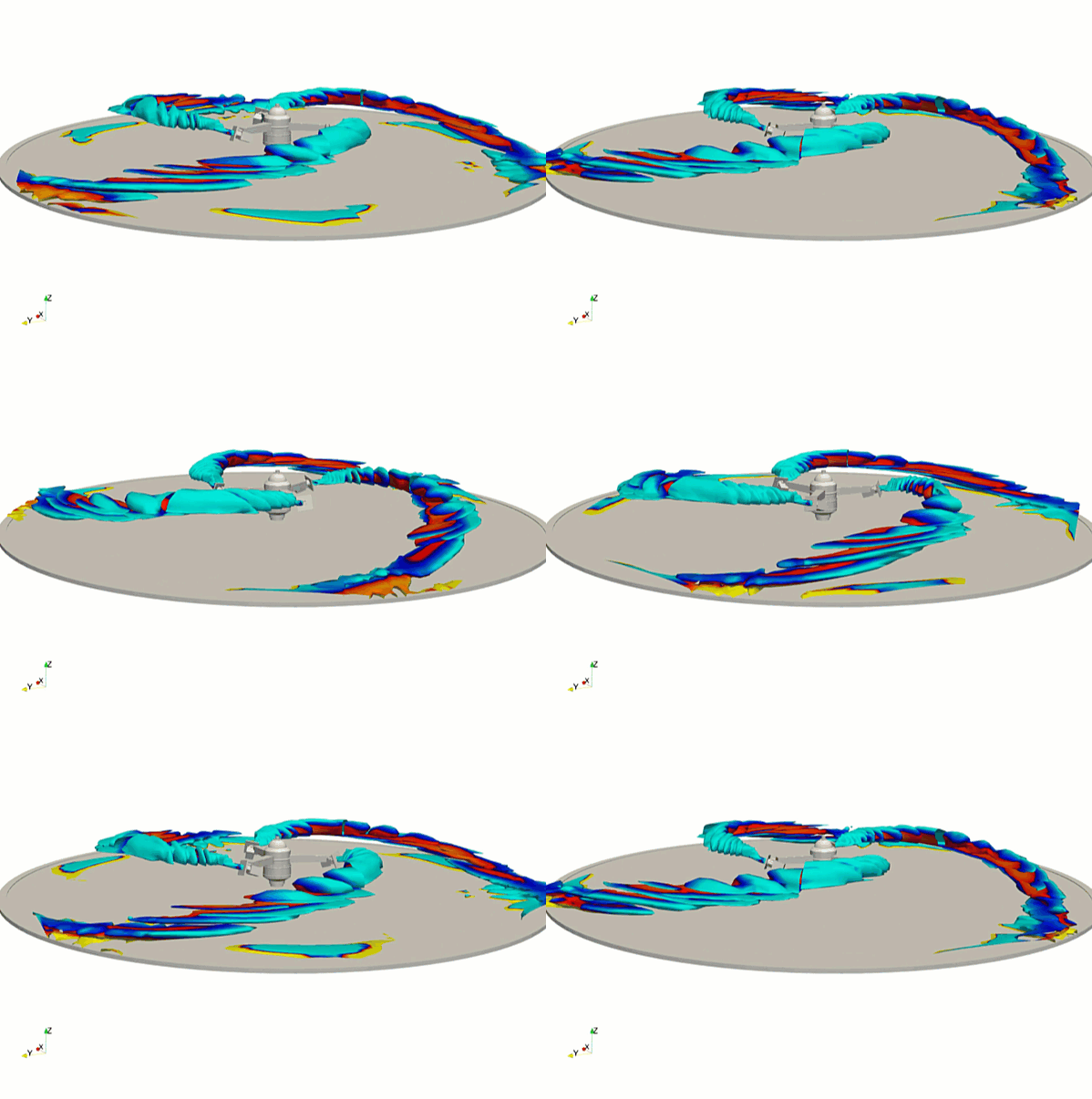
In an increasingly competitive global marketplace, a company’s valuation is intimately tied to its proprietary technology and intellectual property (IP). For engineering-driven organizations—whether operating in aerospace, automotive, renewable energy, or specialized manufacturing—the core vectors of innovation are frequently discovered, tested, and optimized through simulation. Computational Fluid Dynamics (CFD) serves as the primary digital proving ground where these breakthroughs take shape. However, a systemic vulnerability exists within many high-value engineering departments: the heavy reliance on commercial, third-party “black-box” CFD software. By conducting critical research and development within closed-source ecosystems, companies expose themselves to silent IP erosion, regulatory complications, and software architecture traps that can severely damage corporate valuations during fundraising, mergers, or acquisitions.
The Illusion of Ownership in Closed Ecosystems
When an engineering firm develops a groundbreaking product, its executive leadership assumes that the underlying design methodologies and simulation pipelines belong entirely to the company. Under a commercial software model, this ownership is a legal illusion. Commercial CFD packages operate as compiled, binary files where the source code is hidden away from the user. Every physics model, customized boundary condition, and optimized numerical limiter is built upon “rented land.”
If a company’s competitive advantage relies on a highly specialized way of modeling fluid-structure interactions or reactive chemical flows, and that capability is tied directly to a commercial vendor’s proprietary macros or User-Defined Functions (UDFs), the company does not fully own its innovation pipeline. The core IP is inextricably bound to an external software platform. If that vendor alters its API, updates its software architecture, or radically alters its pricing structure, the company’s proprietary workflow can be broken or priced out of existence overnight, deflating the technical valuation of the enterprise.
Technical Due Diligence and Black-Box Dependency Risks
During a corporate acquisition or a high-stakes venture capital funding round, sophisticated investors deploy technical due diligence teams to audit an organization’s technology asset stack. A primary objective of this audit is to evaluate the portability, scalability, and long-term defensibility of the company’s technical infrastructure.
Discovering that a company’s core product optimization relies on a proprietary black-box solver introduces significant risk flags. If your design pipeline cannot be replicated without expensive, recurring per-core licenses from an external vendor, your operational scaling costs become a direct liability to an acquiring entity. Furthermore, because a black box prevents complete transparency, your internal engineers cannot definitively prove how a specific mathematical or physical result is calculated at the source-code level. This lack of mathematical transparency weakens the defensibility of patents and leaves the door open to technological cloning by competitors who use the exact same commercial tools.
The Fragmentation of Proprietary Knowledge
Relying on commercial software inherently fragments an organization’s institutional knowledge. Because engineers are restricted to the pre-packaged features available within a standard graphical user interface (GUI), their ability to embed deep empirical insights into the software is restricted. Custom tweaks, specialized boundary assumptions, and unique material models end up scattered across fragile networks of spreadsheets, local Python scripts, and external text files.
This separation creates an immense operational vulnerability. When senior simulation specialists leave an organization, they frequently take this unstructured, uncompiled knowledge with them. If your company’s unique physics models are not natively compiled into a unified, self-contained software asset, your enterprise lacks a permanent technological moat. True corporate value comes from institutionalizing your engineering secrets directly into your software tools, turning abstract human expertise into an immutable, scalable digital asset.
Compliance, Data Sovereignty, and Export Control Exposure
For high-value sectors such as defense, aerospace, and advanced medical devices, IP protection is not just a commercial priority; it is a strict regulatory mandate. Commercial CFD software vendors are global entities that routinely develop, test, and host software components across multiple international jurisdictions.
This global footprint introduces severe data sovereignty and compliance risks. Many commercial tools utilize cloud-connected licensing systems or mandate the use of vendor-managed cloud servers for heavy meshing and solving tasks. Uploading proprietary CAD geometry or flow characteristics to external servers can inadvertently violate stringent data isolation rules, such as ITAR in the United States or equivalent European defense regulations. A compliance infraction or an unexpected shift in geopolitical export controls can freeze an organization’s software access or expose its most sensitive product data to foreign intermediaries, crippling corporate valuation and damaging market trust.
Transitioning to a Self-Sustaining Simulation Moat
To eliminate valuation risks and secure an ironclad technological advantage, forward-thinking enterprises must claim absolute ownership over their simulation infrastructure. Shifting away from proprietary black boxes and adopting open-source frameworks like OpenFOAM allows companies to construct a completely sovereign software stack.
Because OpenFOAM offers total source-code transparency, every line of C++ code can be inspected, verified, and modified. Companies can natively compile their secret manufacturing parameters, empirical coefficients, and unique boundary behaviors directly into the core libraries of the software. This architectural integration turns the simulation engine itself into a highly defensive piece of proprietary intellectual property. The software can be cloned, scaled, and deployed across an infinite number of private servers or air-gapped high-performance computing clusters with zero third-party licensing dependencies, drastically improving the company’s balance sheet and elevating its technical valuation in the eyes of investors.
Building Your Proprietary Simulation Engine with Tensor CFD
While the strategic value of establishing a custom, in-house simulation pipeline is undeniable, the operational reality of compiling, validating, and managing an open-source code base requires deep software engineering expertise that few product-focused companies possess internally. Tensor CFD acts as your strategic partner to eliminate this implementation gap. We specialize in helping companies develop custom, in-house CFD software built upon a ruggedized OpenFOAM backbone engineered specifically for your proprietary applications. Our team bridges the gap between raw open-source libraries and enterprise utility by handling the low-level source code customization, physics validation, and parallel optimization, while wrapping the entire framework inside a streamlined, modern user interface. By translating your company’s unique engineering secrets into a self-contained, corporate software asset, Tensor CFD removes commercial licensing bottlenecks, guarantees absolute data privacy, and locks in a permanent, high-value technological moat that fiercely protects your corporate valuation.
Leave a Reply