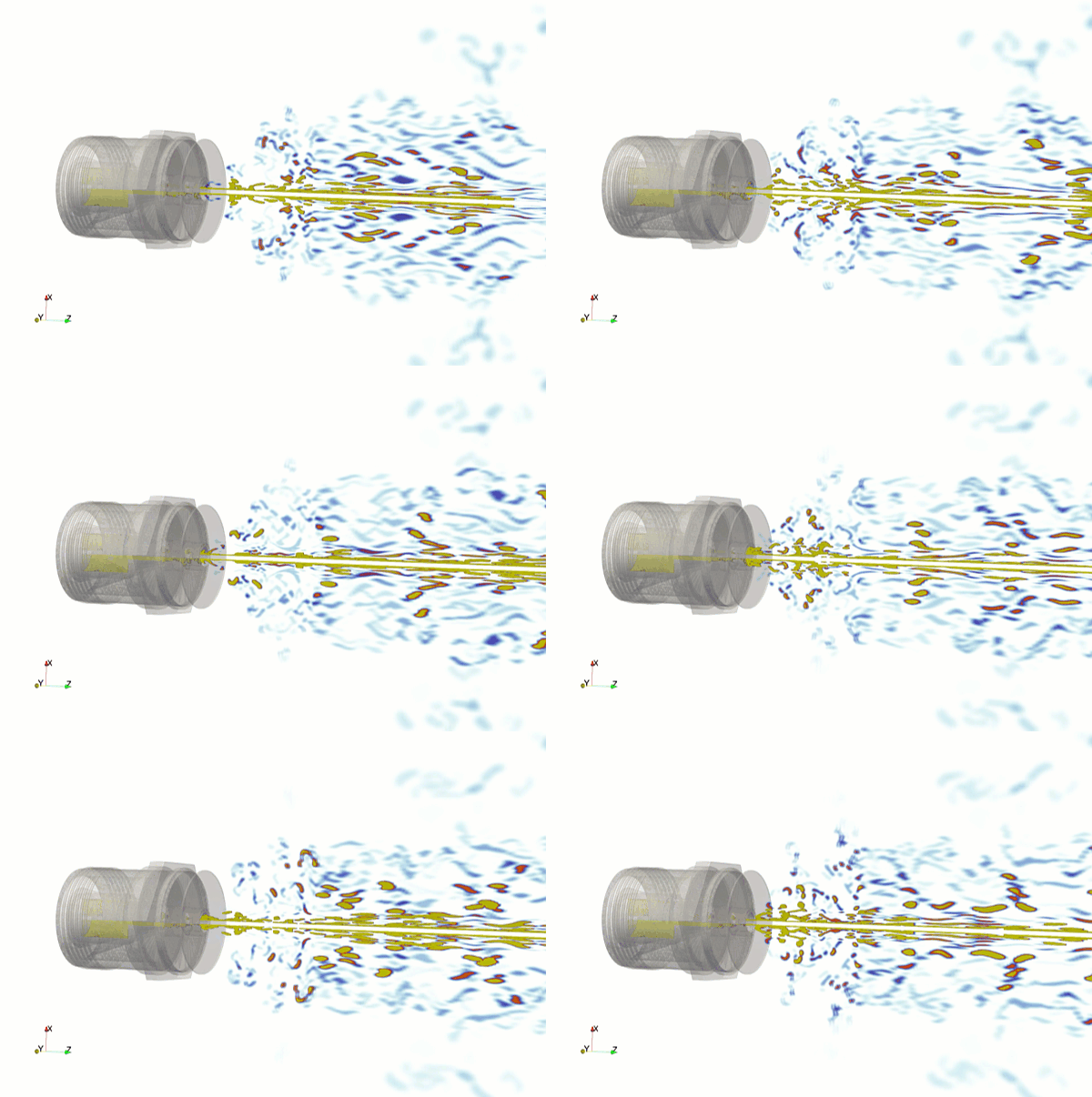
In industrial engineering, a Computational Fluid Dynamics (CFD) simulation is only as valuable as it is reliable. While modern solvers can generate visually stunning flow visualizations and high-resolution pressure plots, they remain mathematical approximations of physical reality. Without rigorous verification and validation, these colorful animations risk becoming expensive guesswork. For engineering departments deploying simulations to make critical design decisions, understanding how to systematically guarantee code accuracy against physical experimental data is the cornerstone of risk management and product safety.
The Distinct Roles of Verification and Validation
To build a reliable simulation framework, engineers must first distinguish between two frequently conflated concepts: verification and validation. In simple terms, verification asks, “Are we solving the equations correctly?” It focuses strictly on mathematics and software engineering, ensuring that the numerical algorithms, spatial discretization schemes, and coding structures accurately represent the underlying governing equations without bugs or programming errors.
Validation, on the other hand, asks, “Are we solving the correct equations?” This process is a direct comparison between the computational results and real-world physical reality. Validation evaluates whether the chosen mathematical models—such as a specific Reynolds-Averaged Navier-Stokes (RANS) turbulence closure model or a multiphase cavitation model—can accurately replicate the actual physical phenomena observed in a laboratory wind tunnel, flow loop, or test rig.
Quantifying Numerical Uncertainty via Grid Convergence
Before a simulation can be fairly compared to experimental data, engineers must isolate and quantify numerical errors. The most prevalent source of numerical error stems from spatial discretization—the mesh. If a computational grid is too coarse, the solver cannot capture localized high-gradient flow structures, such as shear layers or boundary layer separation, leading to unphysical solutions.
To eliminate this variable, validation studies must always begin with a systematic Grid Convergence Study. By executing identical simulations across a series of progressively refined meshes (typically using a constant refinement ratio), engineers can apply the Grid Convergence Index (GCI) based on Richardson extrapolation. This mathematical framework allows teams to estimate the asymptotic limit of the numerical solution and establish a clear error band for spatial discretization. A simulation can only proceed to the validation phase once its grid independence has been mathematically proven.
Designing Compatible Experiments for CFD Comparison
A frequent breakdown in the validation pipeline occurs when engineers attempt to validate a simulation using legacy experimental data that lacks critical boundary information. For an experiment to serve as a high-fidelity validation benchmark, it must be designed with the requirements of numerical simulation in mind. This means capturing precise boundary conditions at the exact spatial boundaries of the computational domain.
If a wind tunnel test records the global lift and drag coefficients of an airfoil but fails to measure the upstream velocity profile, turbulence intensity, or wall temperature distributions, the experimental data is incomplete for validation. The CFD engineer is forced to guess these inlet parameters, introducing boundary condition uncertainty that compromises the validity of the comparison. Modern validation campaigns rely heavily on advanced, non-intrusive diagnostic techniques—such as Particle Image Velocimetry (PIV) for velocity fields and Laser Induced Fluorescence (LIF) for concentration metrics—to provide spatially mapped data points that correspond directly to computational mesh nodes.
Evaluating Statistical and Structural Discrepancies
When comparing verified CFD data against high-quality experimental measurements, validation should look beyond simple global metrics. Matching a single integrated value, like a total pressure drop across a valve or a net thrust force, can create a false sense of security. Solvers can frequently arrive at the correct global answer through a combination of competing, self-canceling errors in different regions of the domain.
True validation requires a localized, multi-point structural comparison. Engineers should extract data along critical geometric profiles, comparing local velocity profiles, skin friction coefficients, and turbulent kinetic energy distributions against experimental data lines. When discrepancies arise, statistical error metrics—such as the Root Mean Square Error (RMSE) or U-values—must be calculated alongside experimental measurement uncertainty bounds. If the simulation results fall consistently within the experimental error bars across diverse operational regimes, the CFD model is considered validated for that specific application envelope.
Standardizing the Validation Pipeline for Enterprise Engineering
For a global engineering enterprise, validation cannot remain an isolated, academic task performed occasionally by specialized research teams. It must be woven into the standard operational fabric of the product development lifecycle. This requires establishing standardized validation protocols, automated regression testing scripts, and centralized databases where simulation methods are constantly cataloged and updated against physical test logs. By treating validation as a continuous, institutional metric, companies build a reliable digital twin framework that shortens physical prototyping cycles and minimizes the risk of late-stage design failures.
Implementing an enterprise-wide, rigorous validation workflow is technically demanding, requiring deep expertise in numerical mathematics, software architecture, and fluid mechanics. If your organization wants to establish an accurate simulation pipeline but lacks the internal infrastructure to automate and validate complex code, Tensor CFD can provide the foundational solution. We specialize in helping companies develop custom, in-house CFD software built upon a ruggedized OpenFOAM backbone tailored precisely to your specific industrial applications. Our team can integrate automated validation loops, grid convergence calculators, and experimental data overlay tools directly into a tailored, user-friendly corporate software application. By combining the open-source flexibility of OpenFOAM with bespoke verification workflows and robust physics tuning, Tensor CFD delivers a production-ready simulation engine that guarantees code accuracy, protects your proprietary data, and completely eliminates recurring per-core software licensing costs.
Leave a Reply