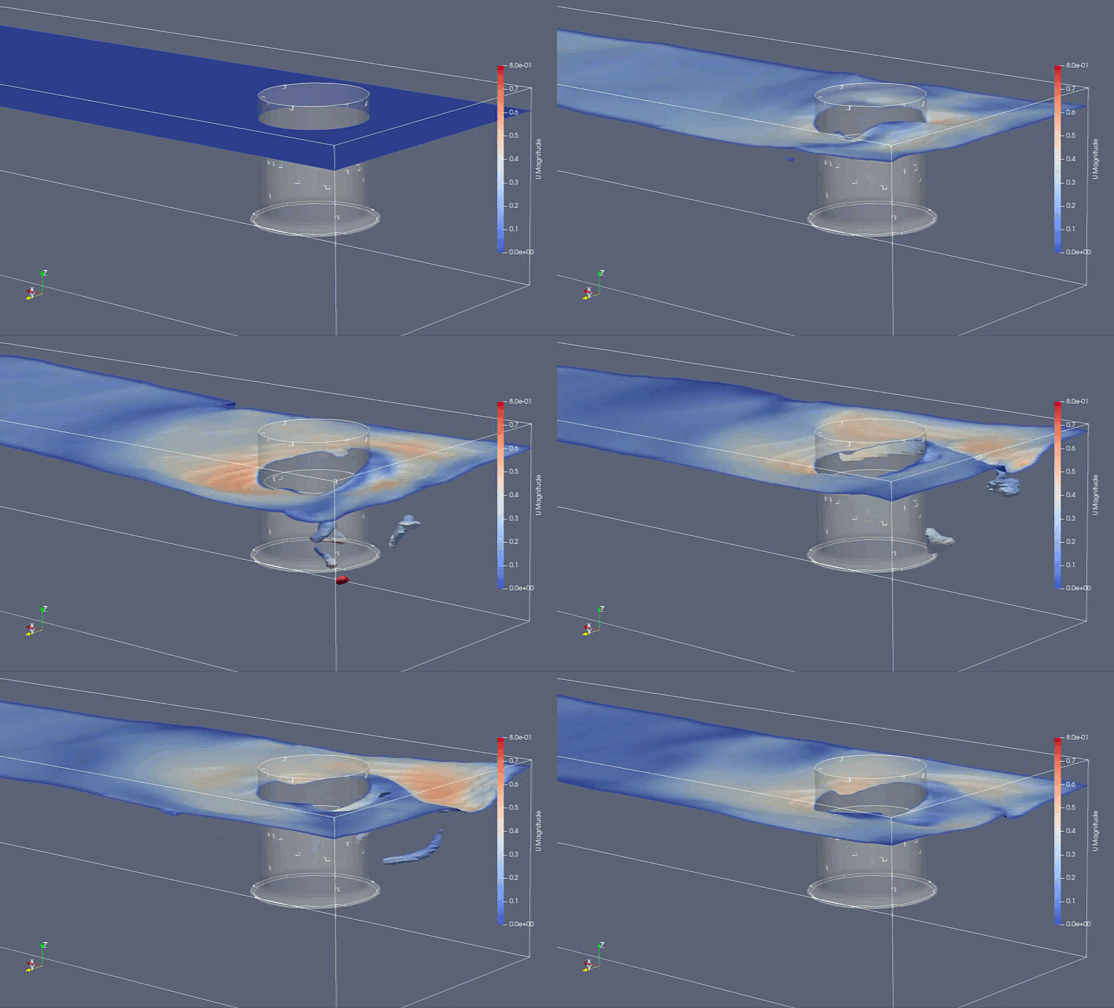
Computational Fluid Dynamics (CFD) is no longer confined to isolated research labs; it is embedded deeply within the core engineering pipelines of aerospace, defense, automotive, and nuclear sectors. Because CFD models are used to optimize critical infrastructure, military hardware, and highly proprietary manufacturing technologies, the data driving these simulations represents an organization’s most valuable intellectual property (IP). Yet, when engineering departments rely on third-party commercial CFD code, they frequently overlook the expansive digital attack surface introduced by proprietary vendor ecosystems. From opaque cloud-based architectures to hidden tracking features and supply-chain vulnerabilities, commercial simulation software introduces subtle security risks that can compromise data privacy and national security.
The Closed-Source “Black Box” and Vulnerability Auditing
The primary security risk of commercial CFD software is its proprietary nature. Distributed as compiled, binary code, commercial solvers operate as absolute “black boxes.” An organization’s internal information security (InfoSec) teams cannot view, audit, or verify the underlying source code for security flaws, buffer overflows, or hardcoded vulnerabilities.
This lack of transparency makes it impossible to perform comprehensive static and dynamic application security testing (SAST/DAST). If a commercial software vendor inadvertently introduces a critical vulnerability into their network communication layer or file parsing engines, that flaw remains completely hidden until a malicious actor discovers and exploits it. Engineering firms are forced to place blind trust in the security hygiene of an external vendor, effectively turning their high-performance computing (HPC) environments into unverified vectors for corporate espionage.
Cloud Synchronization and Unregulated Telemetry
Modern commercial software suites are increasingly shifting toward cloud-connected deployment models. To enforce compliance, manage licensing, and optimize user experience, commercial solvers maintain constant outbound communication channels with the vendor’s home servers. This telemetry data often maps far more than simple usage metrics.
Unregulated telemetry packets can transmit structural data, including active file names, geometric dimensions, project metadata, and user identities across the company firewall. For organizations working on sensitive military components or advanced prototypes, the mere exposure of a project file name or metadata profile can leak vital clues about an upcoming technology to external interceptors. Furthermore, many commercial vendors mandate the use of their proprietary cloud rendering and meshing platforms, which requires uploading raw CAD geometry to third-party cloud infrastructure where data isolation controls are rarely within the client’s direct oversight.
Licensing Dongles, Daemons, and Local Subversion
The mechanism used to restrict and authorize commercial software usage—licensing management software—is historically one of the weakest links in enterprise IT security. FlexNet, Sentinel, and other common licensing daemons require deep, systemic access to the host machine’s operating system to monitor core counts, network adapters, and user sessions.
Because these third-party licensing daemons operate with elevated administrative privileges, they are prime targets for exploitation. A vulnerability within a commercial software license daemon can allow an attacker to achieve local privilege escalation, bypass network firewalls, or move laterally across an enterprise network to access sensitive engineering databases. Furthermore, the physical or virtual software “cracks” and dongle emulators floating through global supply chains to bypass licensing checks frequently come bundled with advanced persistent threats (APTs) and rootkits designed specifically to target corporate engineering networks.
Supply-Chain Attacks and Vendor Intermediation
When an organization buys commercial CFD software, its security perimeter expands to include the vendor’s entire development ecosystem, third-party libraries, and regional support engineers. In a supply-chain attack vector, malicious actors do not target the heavily fortified engineering firm directly; instead, they compromise the software vendor.
By injecting malicious code into an official software update, hotfix, or plugin library, attackers can distribute malware upstream to thousands of high-value corporate clients simultaneously, disguised as a trusted patch. Additionally, resolving complex simulation errors often requires engineering teams to send project directories, mesh definitions, and boundary condition profiles directly to a commercial vendor’s application support specialists. Once this data leaves the corporate network via email or external file-sharing portals, it sits unencrypted on external servers, vulnerable to insider threats or vendor-side data breaches.
Data Sovereignity, Export Controls, and Geopolitical Risk
For companies working within international frameworks like the International Traffic in Arms Regulations (ITAR) or European defense initiatives, data sovereignty is a non-negotiable legal requirement. Commercial CFD code is frequently developed, compiled, and maintained by global teams spanning multiple international borders.
If a commercial software vendor utilizes offshore development teams or routes licensing authentication requests through servers located in geopolitically volatile jurisdictions, the client company faces an immediate compliance risk. A sudden shift in export control regulations, international sanctions, or state-sponsored data access laws can freeze a company’s software access overnight or grant foreign intelligence entities legal avenues to compel data decryption, rendering proprietary simulation pipelines completely vulnerable to external disruption.
Regaining Architectural Control and Security Sovereignty
Mitigating these hidden operational risks requires removing the dependency on external software providers and regaining total control over the simulation source code. Transitioning to open-source frameworks like OpenFOAM eliminates third-party licensing daemons, opaque tracking telemetry, and vendor-dictated cloud storage pipelines completely, allowing enterprise data to remain completely contained within tightly controlled internal security boundaries.
If your company aims to eliminate the systemic security vulnerabilities of third-party software and establish a fortress-grade simulation ecosystem, Tensor CFD can architect a secure solution. We specialize in helping companies develop custom, in-house CFD software built upon a ruggedized OpenFOAM backbone tailored precisely to your specific industrial applications. Because our solutions compile natively and operate entirely on your on-premise or private cloud infrastructure, you can fully audit every line of source code, eliminate dangerous outbound licensing calls, and strictly enforce data isolation protocols. Tensor CFD builds your proprietary physics and automated workflows directly into a self-contained, enterprise-grade software application—giving your engineering team an infinitely scalable simulation platform that permanently protects your corporate intellectual property, satisfies rigorous compliance frameworks, and removes commercial licensing bottlenecks entirely.
Leave a Reply