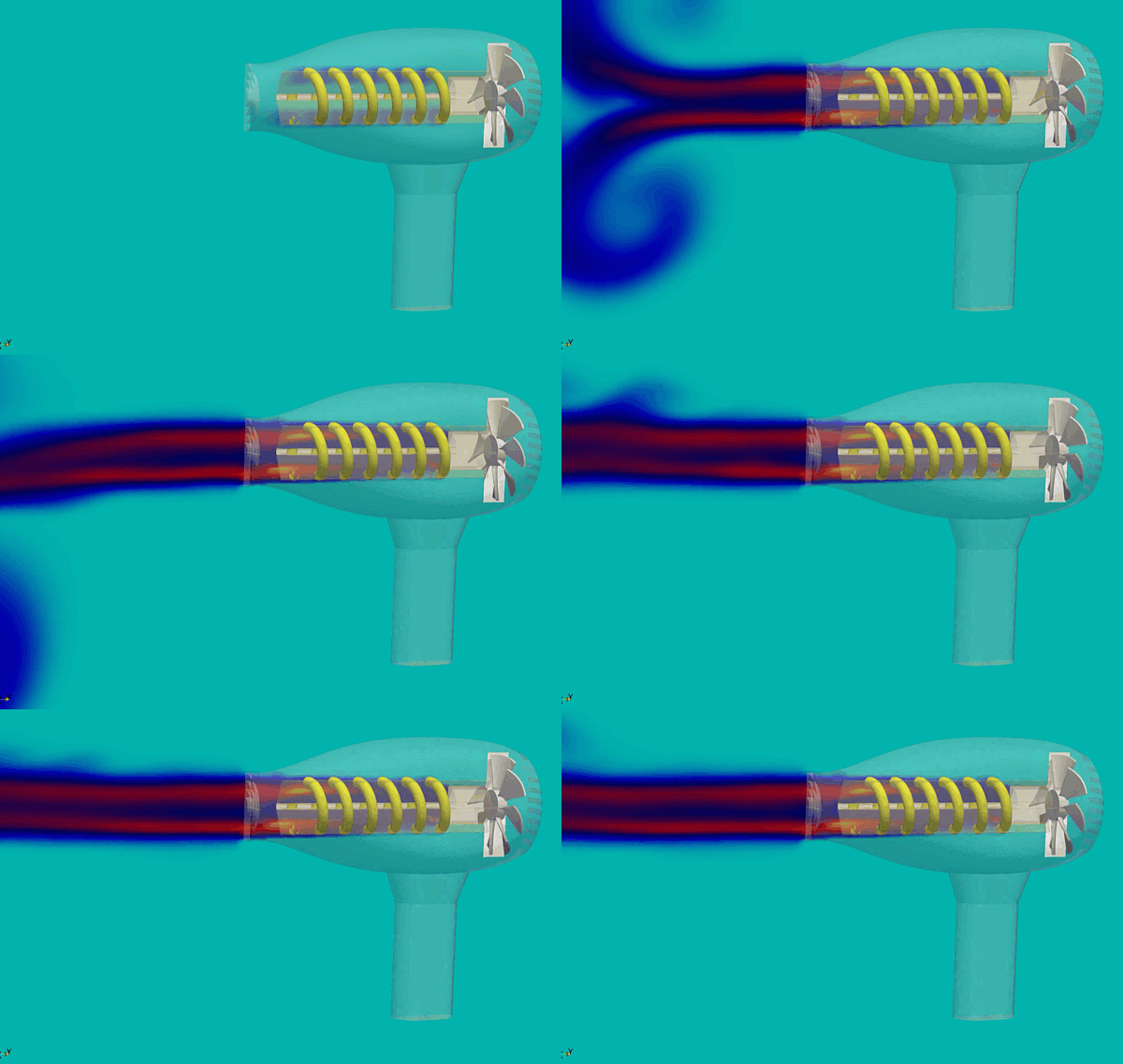
In the realm of Computational Fluid Dynamics (CFD), customization is often the dividing line between standard engineering and breakthrough innovation. When proprietary commercial solvers reach their limits, engineers typically rely on User-Defined Functions (UDFs) to introduce custom boundary conditions, variable physical properties, or basic source terms. While UDFs serve as an acceptable band-aid for minor adjustments, they operate within strict frameworks dictated by the parent software. For organizations pushing the boundaries of physics, manufacturing, or aerospace design, these superficial entry points eventually become bottlenecks. Transitioning to an open-source framework like OpenFOAM opens a fundamentally different avenue of development: the ability to bypass UDF equivalents entirely and modify the source code directly.
The Architectural Limits of User-Defined Functions
User-Defined Functions and their open-source equivalents, such as coded boundary conditions or runtime-compiled functions, are designed to interact with a solver through predefined API hooks. They allow an engineer to inject custom code at specific moments during the simulation timeline—such as before a time-step begins or immediately after a matrix is constructed. However, the core execution path, the matrix inversion algorithms, and the underlying data structures remain completely inaccessible.
This architecture introduces severe performance penalties and logical constraints. Because UDFs often execute outside the optimized loop structures of the main solver, they can cause significant computational overhead, especially when applied across millions of mesh cells. Furthermore, if your application requires a fundamental change to how pressure and velocity are coupled, or if you need to introduce an entirely new transport equation that alters the conservation laws themselves, a UDF simply lacks the structural authority to do so. It is an extension, not a mutation, of the existing software architecture.
Deep Physics Integration and Multiphysics Coupling
The most compelling reason to modify OpenFOAM source code directly is the requirement for deeply integrated, non-standard physics. Advanced industrial applications rarely deal with idealized, single-phase fluids. Engineers routinely encounter phenomena like non-Newtonian viscoelastic flows, complex phase-change kinetics, non-equilibrium thermodynamics, or multi-field physics where fluid dynamics couple directly with structural mechanics or electromagnetics.
When you modify the OpenFOAM libraries directly, you can create entirely new classes of solvers. Instead of trying to trick an existing solver into mimicking a complex physical process via source terms, you can rewrite the governing partial differential equations at the source level. This allows for fully implicit coupling between disparate physical fields, which is inherently more stable and computationally efficient than the explicit, segregated coupling approaches forced by UDF constraints. Direct modification ensures that your custom physics are treated as first-class citizens within the numerical matrix, yielding tighter convergence and far greater predictive accuracy.
Numerical Optimization and Bespoke Discretization Schemes
Standard CFD solvers ship with a robust but generalized suite of numerical schemes, including standard upwind, central differencing, and bounded high-order schemes. While these options suffice for conventional aerodynamics or pipe flows, they often fail in extreme regimes. Applications involving hypersonic shockwaves, detonation waves, or microfluidic surface tension effects demand highly specialized numerical limiters, custom artificial viscosity models, or bespoke discretization schemes to prevent non-physical oscillations without introducing excessive numerical diffusion.
By diving directly into OpenFOAM’s finiteVolume library, developers can implement proprietary numerical schemes tailored precisely to the mathematical behavior of their specific flow regimes. You can modify how face values are interpolated from cell centers, alter the behavior of gradient limiters, or optimize the linear solver preconditions for highly anisotropic meshes. This level of optimization can reduce simulation runtimes by orders of magnitude and achieve stable convergence on complex mesh topologies where standard commercial solvers would completely destabilize.
Streamlining Enterprise Workflows and Eliminating Technical Debt
In an enterprise environment, maintaining a sprawling library of external UDFs, macro scripts, and custom input files creates immense technical debt. Every time a software vendor releases a new version, these external hooks risk breaking due to altered APIs or deprecated functions. Engineering teams waste valuable hours refactoring old UDF code just to keep their legacy workflows functional.
Modifying the OpenFOAM source code directly allows an organization to build a clean, unified, and self-contained software branch. Custom boundary conditions, tailored initialization routines, and specific post-processing utilities can be natively compiled into the core libraries. This structural consolidation simplifies version control, streamlines the onboarding of new engineers, and ensures that the entire custom pipeline compiles as a single, cohesive executable. The software becomes an asset that evolves intentionally alongside the company’s specific manufacturing or research goals, rather than a fragile ecosystem of patches.
Intellectual Property Protection and Competitive Advantage
When a company relies on standard commercial CFD software, its competitors have access to the exact same tools, physics models, and limitations. True competitive advantage comes from knowing something your competitors do not, or being able to simulate a process they cannot accurately resolve. Developing custom code inside a proprietary “black-box” solver is risky; you are building your company’s core intellectual property on rented land, subject to the licensing terms and architectural whims of an external vendor.
Direct source code modification within an open-source framework like OpenFOAM allows a company to build a completely proprietary, in-house simulation engine. Because the modified code is compiled and executed locally, your unique physical models, numerical innovations, and specialized design rules remain entirely confidential. You gain the freedom to scale this custom engine across thousands of high-performance computing cores without triggering per-core licensing fees, translating your unique mathematical insights into a permanent, highly scalable corporate moat.
The Operational Reality of Source-Level Development
Modifying source code directly is a serious engineering undertaking that demands a fundamentally different skillset than typical CFD engineering. It requires moving past the role of a software user and becoming a software developer. Engineers must possess a deep understanding of object-oriented C++, the specific class hierarchies of OpenFOAM, and the intricate mathematical principles of numerical discretization. For many organizations, the sheer complexity of managing git repositories, resolving compilation dependencies, and validating custom numerical schemes creates a barrier to entry that prevents them from unlocking OpenFOAM’s true potential.
If your company recognizes the strategic necessity of moving beyond UDF bottlenecks but lacks the specialized software engineering resources to manage source-level compilation safely, Tensor CFD can act as your dedicated development partner. We specialize in helping companies develop fully custom, in-house CFD software built upon a ruggedized, highly optimized OpenFOAM backbone tailored precisely to your specific industrial applications. By translating your proprietary mathematical models and physical insights directly into core C++ libraries, we eliminate the fragility and performance degradation associated with UDFs. Tensor CFD handles the entire software lifecycle—from low-level architectural design and parallel optimization to the creation of streamlined user interfaces—giving your team a production-ready, infinitely scalable simulation engine that guarantees absolute data privacy, eliminates licensing costs, and locks in a permanent technological edge.
Leave a Reply