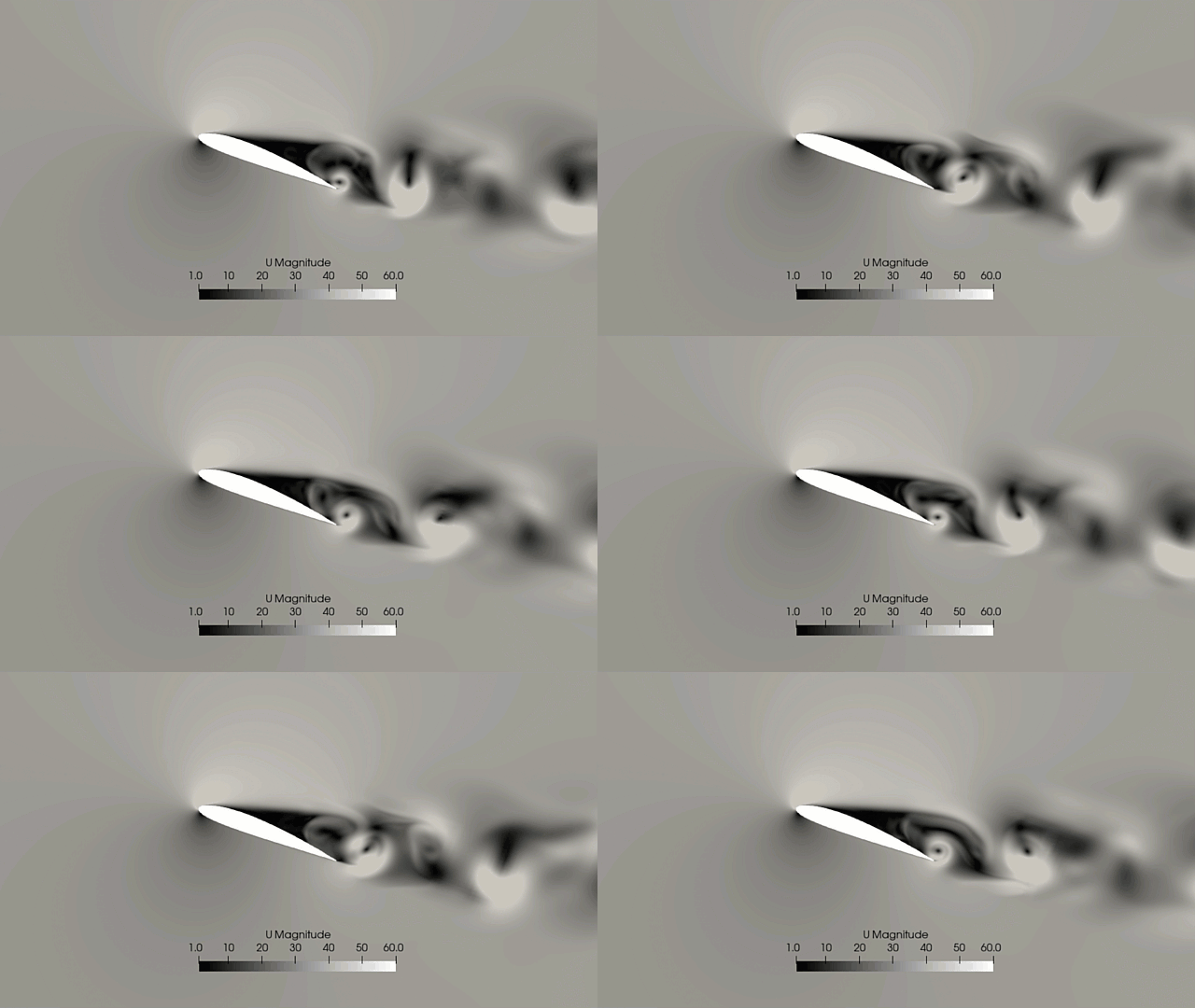
Computational Fluid Dynamics (CFD) has become an indispensable pillar of modern engineering, enabling companies to simulate fluid flow, heat transfer, and chemical reactions before physical prototypes are ever built. As industries face mounting pressure to innovate rapidly while slashing development costs, selecting the right simulation ecosystem is a critical strategic decision. The market is primarily divided into two camps: commercial proprietary software, such as Ansys Fluent or Siemens Star-CCM+, and open-source alternatives, most notably OpenFOAM. Choosing between them requires a deep understanding of how financial structures, technical features, and long-term organizational goals align.
The Financial Framework: Licensing vs. Development Costs
The most immediate distinction between commercial and open-source CFD lies in the cost model. Commercial CFD software operates on a proprietary licensing structure, typically requiring substantial annual subscriptions or perpetual licenses paired with maintenance fees. Crucially, these licenses are often tiered by core count. Running high-fidelity simulations on massive High-Performance Computing (HPC) clusters quickly multiplies licensing fees, creating a financial bottleneck for companies looking to scale their simulation throughput. While this model provides an out-of-the-box solution with predictable upfront expenses, it can penalize growth and restrict extensive parametric design exploration.
Open-source CFD, by contrast, removes licensing fees entirely. Software like OpenFOAM is distributed under the GNU General Public License, meaning an organization can install it on an infinite number of machines and run it across thousands of computing cores without paying a single dollar in software royalties. However, “free” software does not mean free implementation. The financial commitment shifts from external software vendors to internal human resources. Organizations must invest in specialized engineering talent to configure, validate, and maintain the open-source pipeline. The total cost of ownership for open-source tools is back-loaded, determined by the engineering hours required to achieve operational readiness.
User Interface and Accessibility
Commercial solvers excel in user experience, offering highly polished Graphical User Interfaces (GUIs) that integrate the entire simulation workflow—from geometry preparation and meshing to solving and post-processing—into a single, cohesive environment. These interfaces are designed to minimize the learning curve, allowing junior engineers or generalist designers to set up and run standard simulations with minimal friction. Built-in error checking and guided wizards prevent common setup mistakes, ensuring a faster time-to-result for standard industrial workflows.
Open-source CFD traditionally relies on a command-line interface, operating through a series of text-based configuration files known as dictionaries. This text-heavy workflow demands a steep learning curve and a strong grasp of both fluid dynamics and programming logic. Pre-processing and post-processing are decoupled from the solver, requiring engineers to learn auxiliary open-source tools like Salome for meshing and ParaView for visualization. While third-party commercial GUIs exist for open-source solvers, relying on them introduces an additional software cost, partially eroding the initial financial advantage of the open-source model.
Feature Completeness and Physics Modeling
Commercial packages are engineered as all-in-one platforms capable of handling an astonishingly broad spectrum of physics. Whether an engineer needs to simulate aeroacoustics, complex multiphase flows with phase change, fluid-structure interaction (FSI), or combustion kinetics, commercial codes offer validated, pre-packaged physical models. These models are rigorously tested against experimental data across various industries, giving teams immediate confidence in the software’s predictive accuracy. Furthermore, automated mesh generation algorithms in commercial suites can reliably handle complex, dirty CAD geometry with minimal user intervention.
Open-source frameworks are equally powerful but require a more hands-on approach to advanced physics. OpenFOAM boasts an extensive library of solvers and turbulence models that match or occasionally exceed the capabilities of commercial software. However, configuring these solvers for highly specialized applications requires deep domain expertise. If a specific physical phenomenon is not covered by the standard distribution, the engineering team must write custom code or implement user-defined functions. While the raw capability is present, open-source software rarely provides the “one-click” automation found in commercial alternatives, placing the burden of physics validation entirely on the user.
Customization, Transparency, and Innovation
The true battleground between these two paradigms is code accessibility. Commercial software operates as a “black box.” Users cannot view, modify, or verify the underlying source code. If an engineering team discovers a limitation in a numerical scheme or requires a custom modification for a proprietary manufacturing process, they must submit a feature request to the software vendor and wait for a future release cycle. This lack of transparency can hamper cutting-edge research and restrict a company’s ability to develop highly proprietary, specialized simulation workflows.
Open-source CFD offers absolute transparency. Access to the raw source code allows engineers to inspect every governing equation, numerical limiter, and linear solver matrix. This visibility enables unprecedented customization. Companies can modify existing solvers, inject custom physics models, or strip away unnecessary features to optimize execution speed. This level of control is a massive catalyst for innovation, allowing research-driven companies to build unique intellectual property directly into their simulation tools, completely free from vendor-imposed constraints.
Technical Support and Community Ecosystem
The premium paid for commercial licenses guarantees access to dedicated technical support networks. When a simulation crashes or yields unphysical results, engineers can leverage a vendor’s application specialists to debug setups and optimize workflows. This support mitigates project risks and ensures strict engineering deadlines are met. Additionally, commercial vendors provide comprehensive training programs and extensive, structured documentation to onboard new users rapidly.
Open-source support relies heavily on a vibrant, global community of academic researchers and industrial practitioners. Solutions to common problems are found in discussion forums, community wikis, and shared code repositories. While this collective knowledge base is vast, it lacks guaranteed response times or service-level agreements. For enterprise-level reliability, companies using open-source tools often contract with independent CFD consultancies to provide dedicated support, bridging the gap between community-driven development and corporate operational demands.
Strategic Alignment and Decision Matrix
Ultimately, the choice between commercial and open-source CFD is not merely a technical comparison but a strategic business decision. Commercial software is ideal for organizations with standard simulation needs, tight timelines, and a preference for predictable operational expenditures over internal software development. Open-source CFD is the superior strategic choice for organizations looking to scale their simulation infrastructure exponentially, those requiring deep customization to protect proprietary methodologies, and teams with the technical maturity to manage their own software stack.
If your organization aims to break free from restrictive licensing structures and establish a proprietary simulation edge, Tensor CFD can accelerate your transition. We specialize in helping companies develop custom, in-house CFD software built upon a ruggedized OpenFOAM backbone tailored precisely to your specific industrial applications. By blending the infinite scalability and code transparency of OpenFOAM with modern, intuitive user interfaces and automated workflows, Tensor CFD delivers a production-ready solution that eliminates per-core licensing bottlenecks. Our team handles the underlying code architecture, physics validation, and custom solver development, transforming open-source complexity into a powerful, tailor-made corporate asset that drives rapid product innovation.
Leave a Reply