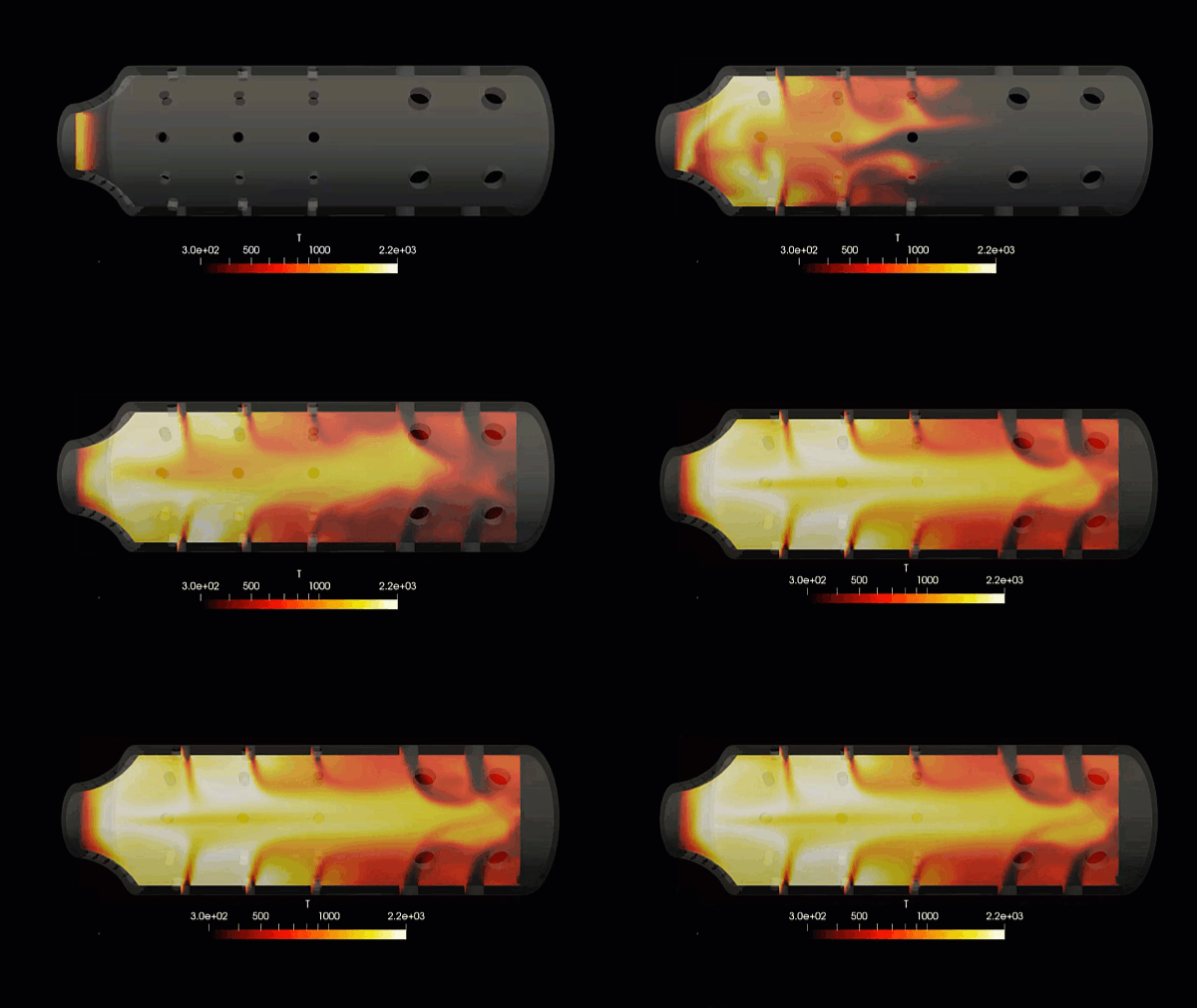
In the world of Computational Fluid Dynamics (CFD), time-to-solution is the ultimate currency. As engineering teams demand higher fidelity models, larger mesh sizes, and more extensive parametric design loops, traditional computing infrastructures face unprecedented strain. Within the OpenFOAM ecosystem—historically built to leverage standard Central Processing Unit (CPU) clusters via Message Passing Interface (MPI)—a massive architectural shift is underway. The rapid maturity of Graphics Processing Units (GPUs) has introduced a powerful alternative for accelerating fluid dynamics workloads. However, transitioning from massive CPU high-performance clusters to GPU-accelerated computing requires a deep understanding of hardware bottlenecks, software compatibility, and the fundamental differences in how numerical linear algebra scales across these architectures.
The Traditional Paradigm: CPU Clusters and MPI Scaling
OpenFOAM was originally architected for distributed-memory CPU architectures. Its parallelization paradigm relies heavily on domain decomposition, splitting the computational grid into discrete subdomains that are assigned to individual CPU cores. These cores compute localized fluid behavior independently and periodically exchange boundary data using MPI.
CPUs excel at handling complex, branch-heavy logic, deep instruction pipelines, and large cache-per-core architectures. This makes them exceptionally reliable for the diverse and highly conditional algorithms found in CFD, such as turbulence modeling, chemistry kinetics, and multi-phase phase change. On traditional CPU clusters, scaling performance is relatively predictable: as you add more nodes, performance scales linearly until inter-node network latency over the MPI fabric becomes the primary bottleneck. However, this model requires massive physical footprints, substantial power consumption, and expensive recurring hardware investments to scale throughput.
The GPU Architecture: Massive Parallelism and Memory Bandwidth
GPUs approach computational fluid dynamics from a fundamentally different hardware philosophy. While a high-end enterprise CPU might feature 64 or 128 highly optimized cores, an enterprise GPU contains thousands of smaller, simpler processing cores designed for simultaneous, massively parallel execution.
CFD is fundamentally a memory-bandwidth-bound problem rather than a raw compute-bound problem. Solvers spend a significant portion of their execution runtime moving large matrices—such as the pressure-velocity linear equations—from memory to the processor. Here, GPUs offer a colossal advantage. Modern enterprise GPUs utilize High Bandwidth Memory (HBM) architectures that provide several terabytes per second of memory bandwidth, dwarfing the memory transfer rates achievable by standard CPU architectures. When a CFD solver can offload its heaviest mathematical matrix inversions to a GPU, the acceleration factor can be transformative, often allowing a single GPU server to match or exceed the throughput of multiple traditional CPU server blades.
Porting the Code: The Challenge of Heterogeneous Computing
Despite the raw performance potential of GPUs, porting OpenFOAM to utilize them is not a trivial out-of-the-box experience. OpenFOAM is a massive, highly abstracted C++ library built over decades with a heavy reliance on object-oriented programming pointers. GPUs, on the other hand, require highly structured, contiguous memory access patterns to achieve maximum efficiency through paradigms like CUDA or ROCm.
Historically, running OpenFOAM on GPUs required external linear solver libraries, such as PETSc or AmgX, to offload only the most computationally expensive portions of the simulation—typically the pressure equation matrix solvers. While this hybrid approach yields performance gains, it introduces significant data transfer overhead. Constant copying of mesh metrics and field data between the host CPU memory and the device GPU memory over the PCIe bus can bottleneck the entire simulation. True acceleration requires native GPU implementations, such as utilizing the modern, performance-portable frameworks (like SYCL or Kokkos) currently being integrated into newer OpenFOAM distributions, which allow the entire solver execution loop to live natively on the GPU.
Comparing the Trade-offs: Linear Algebra vs. Complex Physics
The decision to port workloads to GPUs or expand an existing CPU cluster depends heavily on the specific physics of your CFD applications. GPUs achieve their highest acceleration factors on single-phase, highly structured, or dense matrix calculations where identical mathematical operations are performed across millions of cells simultaneously. Incompressible aerodynamic flows, acoustic propagation, and large-eddy simulations (LES) are prime candidates for massive GPU acceleration.
Conversely, simulations involving highly complex, conditional physics models can struggle on GPUs. If your pipeline involves multi-species combustion, localized radiation models, or dynamic mesh tracking with frequent topological changes, the code paths become highly branched. When threads on a GPU diverge due to conditional logic (if-else statements), execution stalls, severely diminishing the hardware’s parallel advantage. For these highly non-linear, multi-physics applications, CPU clusters often retain their edge in versatility and stability.
Infrastructure, Power, and Total Cost of Ownership
From an enterprise deployment perspective, the choice between GPU and CPU scaling fundamentally reshapes the datacenter footprint. Expanding a CPU cluster to handle massive transient simulations requires a significant investment in rack space, complex network switches, cooling infrastructure, and immense electrical power draw.
A GPU-accelerated infrastructure can drastically lower the Total Cost of Ownership (TCO) for companies with the right simulation profile. Because a compact server containing a few high-end GPUs can deliver the computational equivalent of a multi-node CPU cluster, companies can drastically reduce their physical datacenter footprint. Furthermore, GPUs offer vastly superior performance-per-watt metrics, translating into substantial long-term savings on electricity and thermal management costs, making them a highly attractive solution for cloud-based or space-constrained enterprise deployments.
Navigating the Architectural Transition
Transitioning a corporate CFD pipeline to leverage GPU acceleration requires a meticulous balancing act. It demands a workforce that understands not only fluid mechanics but also low-level GPU programming, memory alignment, and heterogeneous system architectures. For many engineering departments, attempting to manually rewrite legacy OpenFOAM solvers or stitch together volatile third-party GPU libraries introduces unacceptable project risks and extensive software downtime.
If your organization wants to unlock the extreme performance of modern hardware without getting bogged down in low-level compilation bottlenecks, Tensor CFD can architect your next-generation simulation environment. We specialize in helping companies develop custom, in-house CFD software built upon a highly optimized OpenFOAM backbone tailored precisely to your specific industrial applications. Whether your goals demand optimizing code for multi-node CPU clusters or natively porting proprietary solvers to run entirely on high-performance GPUs, our team handles the complex heavy lifting. Tensor CFD bridges the gap by delivering custom-built C++ solvers, seamless hardware integration, and streamlined user interfaces—giving your team an infinitely scalable, production-ready simulation tool that slashes compute times, eliminates commercial software licensing constraints, and locks in a permanent technical advantage.
Leave a Reply